NEWSLETTER

Fall 2003

Page 2

Page 3

Page 4

VIDEO REVIEW

(info@skfbooks.com) and produced by International Documentary Television Corp.  It is available through Different Roads to Learning (www.difflearn.com) and costs about $20. ¤

Page 5


One section offers sample letters that are invaluable.  Another takes the mystery out of test scores.  Writing "Smart IEPs" is explored in another.

I would encourage all parents to read the book and use it as a resource, not only during difficult times but also before a complicated issue arises.  Being prepared is one way to be an excellent advocate for your child, and this book with help you do so confidently.


Harbor House Law Press publishes the book, a 382 page soft cover.  It is available through Different Roads to Learning (www.difflearn.com) and other booksellers.  The list price is $29.95. ISBN: 1892320088. ¤

cific to your child.

That disclaimer out of the way, in a nutshell, my opinion is that it is entirely possible that your child may be functioning in the mentally retarded range, without being truly retarded. To expand on what I mean, consider the criteria for the diagnosis of mental retardation.  According to the DSM-IV TR, there are three criteria for mental retardation:

1. IQ measured to be two standard deviations or more below the mean.
2. Significant adaptive living skill deficits.
3. Onset before age 18 (in other words, before development is considered to be completed).

Does your child meet these three criteria?  A great many students diagnosed with autism spectrum disorders (ASD) do.  My central question, however, is whether this measured intellectual deficit is merely a reflection of current behavioral, communicative, and social difficulties.  Consider the requirements of standard intelligence tests: They generally require the student to interact with the tester, answer questions, follow directions, imitate, and receptively or expressively identify requested items.  Many students diagnosed with autism have simply not learned these skills at the time of testing.  Following effective programming, IQ may jump by dozens of points (eg, Lovaas, 1987).  Did you magically increase the student's intelligence, or did you help the individual to develop the skills that allowed the child to participate in the test? I would argue for the latter explanation.  Just what is intelligence anyway?  Is it some general factor, or a collection of specific factors?  A person whose name escapes me once said that intelligence is what intelligence tests measure. 

Consider another issue: I do some work in Eire, Ireland, and was in the Dublin airport after one of the consulting trips with my friend and colleague Meredith Needelman (a particularly wonderful speech therapist).  She was reading a story to me from a magazine about some movie star. At one point, Meredith realized I was looking at her blankly, smiled and said "you have no idea who I'm talking about, do you?"  I'm afraid I didn't.  I couldn't identify 98% of the celebrities out there if you put a gun to my head.  It's just not my area of interest.  Call me a cultural illiterate.

Why do I mention this?  Consider that many students diagnosed with ASD are not exposed to many life experiences that provide the knowledge neces

Page 6

sary to answer questions on the IQ tests.  I'm thinking of a student I tested a few years ago.  When I first met the student, he was not toilet trained, could not speak, and only consumed Pediasure for nutrition.  After a year of very serious effort by staff and family, all of these deficits were ameliorated, and he was able to participate in an IQ test that included a verbal picture identification component.  The child labeled a great many items, but missed others I thought he would know.  When I went over the results with his mother, I asked if her son had ever seen one of the farm animals on the test.  Mom looked at me like I had eight heads, and asked if, considering his former deficits, I thought they were taking him to petting zoos that frequently. The answer was fair enough, but conditions were different now.  So I called a bunch of people into the room who were a lot smarter than me (his teacher, speech therapist, and teacher assistants) and we planned a year's worth of field trips that the family and school would take each week to expose him to missed experiences.  We went over a bridge and through a tunnel, to the zoo and an aquarium, to the baseball game, to the ocean, to the forest, and more.  I should also mention that on that same intelligence measure, the child scored three standard deviations above the mean on one of the other subtests that did not directly assess expressive language.

To consider the question as regards your son, we need more information.  What sort of test was used? Did it have verbal and nonverbal components?  Was there a big spread among the subtests?  Was it a test appropriate for someone of his age? Was the test ever standardized for people with disabilities?  Was the test conducted properly?  Was the test conducted by someone with whom the student was familiar, and in a familiar setting, or was the test done in such a way that the student was not comfortable or motivated?

Was there a measure of adaptive behavior collected?  These are often assessments that do not directly test the student, but rather interview significant others to compare the child's behavior to age-standardized norms.  If so, was there a spread among subscales?  A large spread, particularly with some subscales in or around the normal range, would argue against a mental retardation label.  Finally, was the adaptive behavior test done properly?  I kid you not, I have heard of such tests being conducted by mailing the questionnaire to parents, a completely inappropriate use of such measures.

Page 7

Among this year's selection of topics are various workshops and presentations that may be of special interest to families, educators and other service providers, including:

Using Video Modeling to Teach Play Skills in Children with Autism Spectrum Disorders

Using Photo Activity Schedules for Achieving Independent Performance in Children with Autism

Developing Appropriate Staff Training Techniques to Improve Staff and Student Performance

Play Groups for Young Children with Autism Spectrum Disorders

Sense, Sensibility, and Cost-Benefit of Early Intensive Behavioral Intervention in Autism

Recent Research on Assessing Preferences and Reinforcers in Individuals with Special Needs

Functional Analysis of Severe Behavior Disorders

Teaching Functional Communication to Young Children with Autism: Practical Examples and Their Relation to Current Research

Challenging Cases

Last year, over 350 individuals from 15 states and 2 foreign countries attended the BABAT conference.

Lunch will be provided each day of the conference. APA and BCBA continuing education credits will be available. See our continuing education booth at the conference for more information.

For more conference and registration information, please visit the BABAT web site, www.babat.net.


(Editor's Note: Dr. Harchik is a licensed psychologist and clinical supervisor at the May Institute, and a board member of Berkshire Association for Behavior Analysis and Therapy.)
¤


Page 8

Difficult Behavior and
Children with
Autism Spectrum Disorders
Functional Behavior Assessment Training at
SERC Workshop


Difficulties understanding language, sensory issues, social skills deficits, anxiety, and the need for highly structured environments can result in challenging behaviors for children with autism spectrum disorders. It is important to identify the communicative intent and function behind any given behavior in order to develop effective intervention strategies.


On March 2 and March 24, the SERC Focus on Autism Initiative will sponsor a 2-day workshop led by Linda Grimm,  Director of Benhaven Learning Network in Wallingford,

CT.  The workshops will be held at Keeney Center in Wethersfield, CT  from 9:00 AM to 3:30 PM, and are open to professionals and family members of children with autism from Pre-K to grade 6.


On day one of this two-day workshop, participants will examine principles of behavior and the use of hypothesis and data to design specific interventions. Participants will learn to assess the environmental factors through conducting functional behavior assessments. Participants will return to their districts with the expectation that they will collect data and complete an environmental assessment.


Day two is intended to support participants in the creation of a positive behavioral support plan based on the information collected in-district.


Participants will:

(Continued on page 18)

Page 9

Page 10

Page 11

Ray Cepeda, BA . Workshop Leader for The LOVAAS Institute.
Sponsored by The ELIJA Foundation in Conjunction with the Dept. of Health's LEICCAC (Local Early Intervention Coordinating Council Autism Committee).  Certificate Workshop.
8:30 Pre Registration 9-5 workshop
Topics to be covered:
1. Principles of Reinforcement
2. Pairing Learning with Reinforcement
3. Conducting Reinforcer Assessments
4. Functions of Behavior/Reducing Behaviors
5. Evaluating the Teaching Situation
6. Generalization
7. Discrete Trials
8. Incidental Teaching
9. Curriculum Development and Flowcharting
10. Shaping and Chaining
11. Prompting and Fading
12. Roles and Responsibilities of Supervisors/Consultants, and Team Leaders.
13. Common Treatment Mistakes
14. Discrimination Learning/Expanded Trials
15. Data Collection and Graphing
There will also be a question answer period.
Cost: $35.00
For more information, please call 516-433-6200, or visit the Elijah web site www.elijah.org.

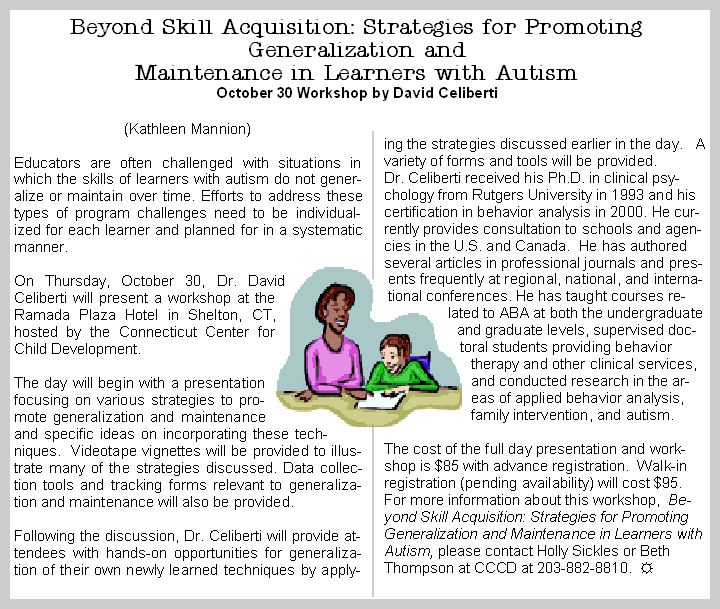
October 30, 2003
Ramada Plaza Hotel
Shelton, CT
BEYOND SKILL ACQUISITION: STRATEGIES FOR PROMOTING GENERALIZATION AND
M
AINTENANCE IN LEARNERS WITH AUTISM
David Celiberti, Ph.D.
Sponsored by the Connecticut Center for Child Development 
9AM-4PM
The cost of the workshop is $85 with advance registration.  Walk-in registration (pending availability) will cost $95.  For more information please contact Holly Sickles or Beth Thompson at CCCD at 203-882-8810

Please see the related article elsewhere in this issue of the CT FEAT Newsletter.

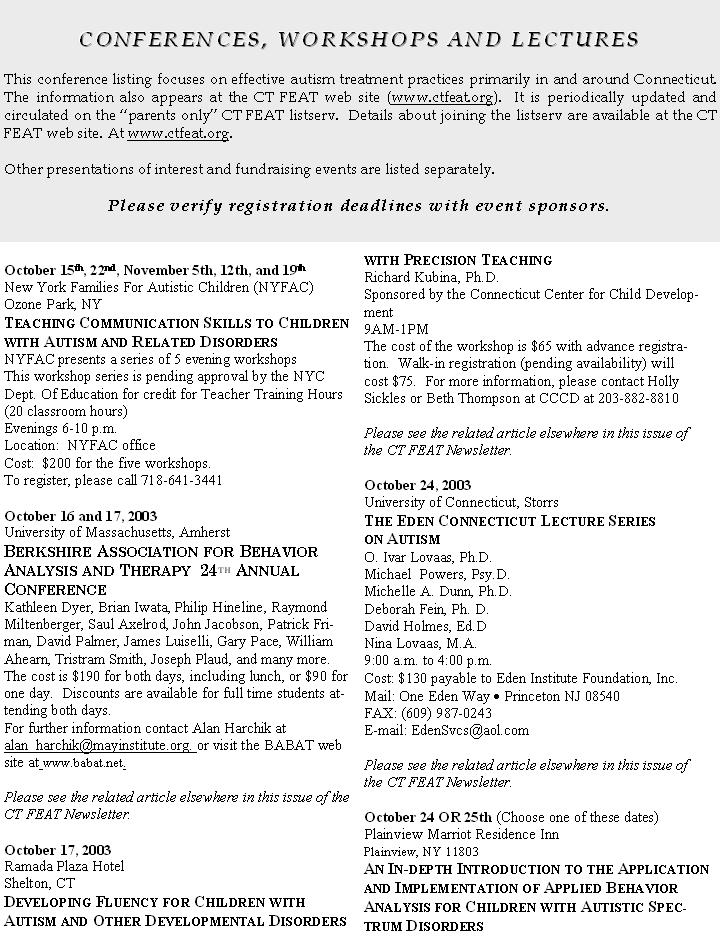
November 7th & November 8th, 2003
White Plains, New York
10TH ANNUAL STEPPING INTO THE FUTURE CONFERENCE
The Foundation for Educating Children With Autism (FECA)
Keynote speakers will be Richard M. Foxx, Ph.D.,BCBA and Eric Hollander, M.D.
Other speakers include Peter Gerhardt.
For more information call 914-941-3322. or visit the FECA

web site at  www.fecainc.org.

November 13-14, 2003
Saratoga Springs, New York,
NEW YORK STATE ASSOCIATION FOR BEHAVIOR ANALYSIS (NYSABA) 13TH ANNUAL CONFERENCE
"B
EHAVIOR ANALYSIS: ENRICHING EVERYDAY LIFE"
Co-sponsored by the New York State Speech-Language-Hearing Association
KEYNOTES:
STATE OF THE ART IN COMPREHENSIVE TREATMENT OF ADHD: BEHAVIORAL, PHARMOCOLOGICAL, AND COMBINED TREATMENTS
Dr. Bill Pelham,

THE FOUR-TERM CONTINGENCY: A CONTEXT-BASED MODEL OF PROBLEM BEHAVIOR IN AUTISM
Dr. Edward (Ted) Carr

WHAT'S NEW IN EARLY INTENSIVE
BEHAVIORAL INTERVENTION?
Dr. Tristam Smith

Other nationally recognized experts will discuss a wide range of topics including:
autism/developmental disabilities, effective teaching in schools, experimental analysis, community applications, social and professional issues, families and biological factors.
CEUs AVAILABLE FOR SPEECH THERAPISTS AND BEHAVIOR ANALYSTS
Register by October 30, 2003
For more information, please visit the NYSABA web site at www.nysaba.org, or contact:Helen Bloomer at (518) 384.3833 , or by fax (518) 384.3834 or e-mail at bloomerxroads@aol.com.

January 7th, 14th, 21st, 28th, and February 4th
New York Families for Autistic Children (NYFAC)
Ozone Park, NY
TEACHING SOCIAL SKILLS AND PLAY SKILLS
NYFAC presents a series of 5 evening workshops
Evenings 6-10 p.m.
Cost:  $200 for the five workshops.
To register, please call 718-641-3441

January 10 2004
Plainview Marriot Residence Inn
Plainview, NY
PROMOTING FUNCTIONAL COMMUNICATION, COOPERATION, AND LANGUAGE SKILLS IN CHILDREN WITH AUTISM SPECTRUM DISORDERS, USING ABA
Tamara Kasper, MS/CCC-SLP Speech-Language Pa

Page 12


thologist, Board Certified Associate Behavior Analyst
Sponsored by The ELIJA Foundation in Conjunction with the New York Dept. of Health LEICCAC
The purpose of this workshop is to describe and demonstrate methods of effective teaching for children with autism as found in the literature of Applied Behavior Analysis as well as evaluation and treatment procedures which have been proven effective in the field of speech-language pathology. The methods and materials developed by Drs. Sundberg and Partington and published in their manuals "The Assessment of Basic Language and Learning Skills"(1998) and "Teaching Language to Children with Autism and Other Developmental Disabilities"(1998) will be combined with procedures popularized by Dr. Vincent Carbone and procedures developed within the field of speech-language pathology.
8:30 Pre Registration 9-5 workshop
For more information, please call 516-433-6200, or visit the Elijah web site www.elijah.org.

March 2 and March 24
Keeney Center
Wethersfield, CT 
DIFFICULT BEHAVIOR AND CHILDREN WITH
A
UTISM SPECTRUM DISORDERS
Linda Grimm,  Benhaven Learning Network
SERC Focus on Autism Initiative will sponsor a 2-day workshop open to professionals and family members of children with autism from Pre-K to grade 6.  Topics to include evaluating communicative intent, functional and environmental assessment, data collection and creating positive behavior support plans.
The cost for the 2-day event is $50.00 per person, and includes text. For more information, please contact: Carol Hotz. Administrative Assistant, (860) 632-1485, ext. 232

Please see the related article elsewhere in this issue of the CT FEAT Newsletter.

April 28, 2004
Radisson Hotel,
Cromwell, CT
Social Skills Symposium
Exploring the Social Skills Needs of Students with Autism Spectrum Disorders, PreK-Grade 12
Planning for Effective Social Skills Interventions
Michael Powers, Psy.D.
How can school personnel and families address the social skills deficits of children with autism
spectrum disorders through planful programming? This keynote address will explore various
programmatic issues, including staff training, developing quality individualized education
programs (IEPs), assessment of social skills, and strate

Page 13

15, 2003.  Presentation details will be available through the ABA web site, www.abainternational.org.

The ABA annual international convention is held every year over the Memorial Day weekend.  The 2003 ABA Convention, held in San Francisco, included over 2000 participants from 32 different countries.  Autism treatment was the focus of over 100 presentations.  Audiotaped copies of selected past presentations can be obtained by contacting the Association for Behavior Analysis at (269) 492-9310 or by E-mail: at mail@abainternational.org .
¤


Association (LACASA) and Education Connection, with funding  provided by a Sliver Grant from the State Department of Education, through the East Hartland Schools.
For more information, please contact: Nancy Luchene at Education Connection, 860-567-0863, ext. 117.

November 21-22, 2003
Farmington, CT
Individuals and Families Leading Self-Determined Lives
A Combined Family Support and Self-Determination Conference
Topical workshops will cover self-determination and effective self-advocacy, models of family support, community partnerships, resources, health, special education, behavioral health, financing, legal issues, communication, and more. Vendors will be on-site with products and information. Join us for two days of networking, learning, and having fun with old friends and new acquaintances.
For more information, please contact Molly Cole at (860) 563-3232 or e-mail: FAVORCT@aol.com or Yvette Johnson at (860) 418-8709 or e-mail: yvette.johnson@po.state.ct.us.

December 4, 2003
Education Connection
Litchfield, CT
Inclusive Recreation
James McGregor, ED. D.
12-3PM
Sponsored by The Litchfield County Autism Spectrum Association (LACASA) and Education Connection, with funding  provided by a Sliver Grant from the State Department of Education, through the East Hartland Schools.
For more information, please contact: Nancy Luchene at Education Connection, 860-567-0863, ext. 117.

December 9, 2003
Rensselaer,
Hartford CT
A
N INTRODUCTION TO AUTISM SPECTRUM
D
ISORDERS
Mark Greenstein, M.D.
Judy S. Itkowitz, Ph.D.
$40.00 per person
Contact: Carol Hotz 
(860) 632-1485, ext. 232
Register By: November 19, 2003

For more information, please visit the SERC Focus on Autism Event Calendar at http://www.ctserc.org/

(Continued on page 14)

Other Presentations
of Interest


October 25, 2003
New Canaan, CT
Inclusive Education: Promising Practices
This conference will focus on inclusive education and best educational practices for students with developmental disabilities. It is sponsored by the New Canaan Public Schools, Department of Special Education.
For more information on the conference, please contact Beth Lurie at (203) 966-2982 or e-mail: lurie@optonline.net.

October 29
Education Connection
Litchfield, CT
The Role of Medication in Controlling Autism Symptoms
Edward Kavle, MD
7-9 PM
Sponsored by The Litchfield County Autism Spectrum Association (LACASA) and Education Connection, with funding  provided by a Sliver Grant from the State Department of Education, through the East Hartland Schools.
For more information, please contact: Nancy Luchene at Education Connection, 860-567-0863, ext. 117.

November 6, 2003
Education Connection
Litchfield, CT
Adaptive Recreation
Kathy Radzunias, CTRS
7-9PM
Sponsored by The Litchfield County Autism Spectrum

Page 14

Page 15

Page 16


and 44. It is centrally located in northwestern region of the state, twenty-five miles west of Hartford and twenty-seven miles north of Waterbury.


Course: PSYCHOLOGY 218
The Child With Special Needs

Taught by:  Staff
Mondays, 6:30-9:30 P.M.

Course description:  Special Children, who they are, how they behave, and what can be done to help them.  Emphasis on the child in the home and in social environments; school-related problems.

Course:  PSYCHOLOGY C258
Behavior Modification
Taught by:  Robert J. Beck, Ph.D.
Thursdays, 6:30-9:30 P.M.

Course description:  This course will investigate the events that influence and control our actions.  Students will learn how to assess and develop environments to facilitate and maintain behavior changes.

To register for this course, or any other NCCC course, call NCCC at (860) 738-6314.


University of Connecticut
Torrington Campus

Location: The University of Connecticut's Torrington Campus is located high in a rural Setting off Route 4 in Torrington, Connecticut. Ample parking for all students is always available.

Course:  PSYCHOLOGY 249 - EmotionalBehavioral Disorders of Childhood
Taught by:  Celine Saulnier, Ph.D.
Thursdays, 6:30-9:00 P.M
.Dr. Celine Sauliner has a Ph.D. from the University of Connecticut and is currently doing postdoctoral work at Yale with well known autism specialist Dr. Ami Klin.
Course description:
  Theory, research, treatment, and prevention in developmental psychopathology from infancy through adolescence.

The Spring semester begins on Tuesday, January 20, 2004. 
For more information, call UCONN-Torrington at (860) 626-6800.
¤

Page 17

cerns you, make a note of it.  Schedule an appointment to discuss the issue with the teacher at a later date.  Do not try to have an impromptu meeting during class time.  The teacher usually has other students that need her attention during regular school time.

Some parents have told me that their school doesn't encourage them to come in because it upsets the child. Early on my consultant said if the parent coming in upsets the child, then the parent needs to come in more often. That way the child gets used to the parent coming in & it's "OK, Mom's here. No big deal".

By getting into the classroom to observe your child, you can support the staff's efforts at home.  Our children learn best when both the home and the school are working together toward the same goals.
¤

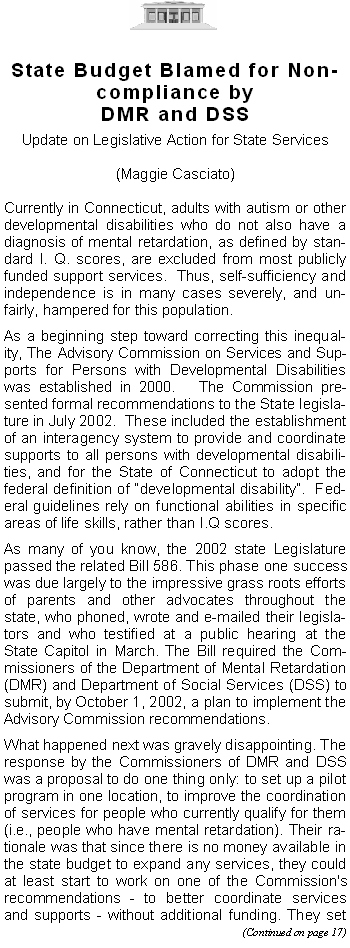
(Continued from page 9) Legislative Action Update

up an inter-agency workgroup to study the problem and develop the pilot program, with a timeline of a minimum of two years.

While we recognize the severity of the state deficit and the current budget crunch, there are two things very wrong with this response: first, it does not help people who are currently denied services (the reason the Commission was established in the first place), and secondly, it is not a plan to implement the Commission's recommendations. The Commissioners did in fact, not fulfill Bill 586's requirements and remains out of compliance with the provisions of the Bill.

(You can read the full text of this response at the DMR's web site. Go to www.dmr.state.ct.us and click on the link for the "Interagency Developmental Disabilities Workgroup". Then click on Meeting Summaries and Documents, and then "Read the DMR/DSS Proposal".)

Since then, Lois Rosenwald and I have established a committee to represent groups of citizens with developmental disabilities who are currently denied services; i.e. people with cerebral palsy, neurological issues, and severe learning disabilities.  The goal of the Connecticut Action Committee for Developmental Disability Systems Change is to actively raise awareness of this issue via media and by contacting and educating our state legislators. You can help by writing or phoning your own state representatives. Let them know that the inadequate response to Bill 586 is unfair and unacceptable; ask them to speak up about this issue, and push for corrective action.   

The Connecticut Action Committee for Developmental Disability Systems Change has recently formed a subcommittee to explore potential civil rights violations concerning the inequities of qualification for support and the distribution of state services.

The lack of current funding certainly does not prevent the development of a blueprint for full implementation as mandated by Bill 586.  Without that action by the Commissioners of the DMR and DSS, many people question whether the Commission's recommendations are being taken seriously by these agencies.


For more information, please call Lois Rosenwald at the CT Autism Spectrum Resource Center at (203) 248-5222. ¤

Page 18

(Continued from page 8)Functional Behavior Assessment Training at  SERC Workshop

evaluate the communicative intent behind specific behaviors of children with autism spectrum 
disorders, assess various environmental conditions and factors relating to the specific behavior;  conduct a functional behavior assessment and create a positive behavioral support plan;  collect data and make programmatic decisions on intervention strategies; and  reflect on the process used to address challenging behaviors of children with autism spectrum disorders, PreK-grade 6.


Priority will be given to teams; although, individuals may apply as space allows. CEUs are available.

The cost for the 2-day event is $50.00 per person, includes text, and is payable to Rensselaer at Hartford.  For more information, please contact: Carol Hotz. Administrative Assistant, (860) 632-1485, ext. 232

The SERC Focus on Autism Event Calendar can be viewed at http://www.ctserc.org/calendar/IDEA/autism.shtml  .¤

RESEARCH OPPORTUNITY

UNIVERSITY OF CONNECTICUT STUDY SEEKS PARTICIPANTS

PARENTING A DISRUPTIVE CHILD?


You and your child may be eligible for free
behavior treatment as part of a study at the
University of Connecticut.


If your child is between the ages of 5 and 18, displays aggression, disruptions or self-injury, and has special needs due to developmental delay, mental retardation, or autism, you may be eligible to participate.

Treatment will be offered in Waterbury, West Hartford or Storrs, and will involve noncontingent reinforcement (NCR), which has demonstrated initial
efficacy for treating behavior disorders in previous studies.

Pretreatment evaluation will consist of an initial telephone interview to discuss the behaviors of concern, to be followed by  a functional analysis of the problem behavior.  Based on results, families will either be recommended to the treatment phase or given community referrals.

Treatment will involve the child and family, and will last about 2-3 months.   Weekly or bi-weekly sessions will be conducted to decrease the problem behaviors, train the parents to implement the procedures, and work on generalization to home and school as appropriate.

The study is being conducted by Kimberli Treadwell, Ph.D., Assistant Professor of Psychology at the University of Connecticut.  Dr. Treadwell is examining why the procedure of NCR is effective in treating problem behaviors.  She trained at the Kennedy Krieger Institute, in conjunction with Johns Hopkins University School of Medicine, in assessment and treatment of severe behavior disorders secondary to
developmental disability or neurological insult.


This study has been approved by the Internal Review Board of the University of Connecticut.


For more information please contact:
Dr. Kim Treadwell, University of Connecticut, Department of Psychology, at 203-236-9849, or by e-mail at kimberli.treadwell@uconn.edu. ¤

RESEARCH OPPORTUNITY


Baby Hair Still Needed for
National Autism Research Study

Arizona State University is conducting a research study of the levels of mercury, toxic metals, and essential minerals in the baby hair of children with autism compared to non-autistic children. The purpose of this study is to replicate two previous studies: A study by Dr. Amy Holmes et al. that found very low levels of mercury in the baby hair of children with autism, and our recent study (submitted for publication) which found low levels of several essential minerals in children with autism.

This study will test "first-cut" baby hair between 12 and 24 months of children with autsim and typically developing children born between 1988-1999.  Participants will receive the results of their child's hair analysis, a $20 gift certificate to Toys `R' Us, and a copy of the study findings.
   
For  more information on participating in this important study, please contact us by e-mail at Jromdalvik@aol.com , or by postal mail to Prof. James B. Adams, Arizona State University, PO Box 876006,  Temple, AZ 85287-6006.¤

Page 19


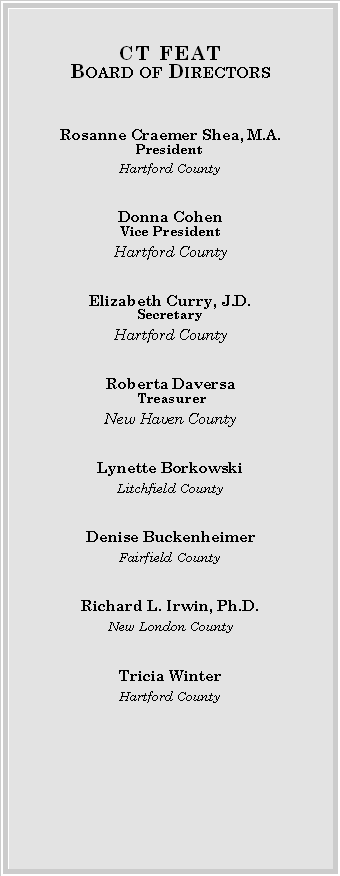
CT FEAT, I
NC.
B
OARD OF DIRECTORS

Rosanne Craemer Shea, M.A.
President

Hartford County

Donna Cohen
Vice President

Hartford County

Elizabeth Curry, J.D.
Secretary

Hartford County

Roberta Daversa
Treasurer


New Haven County

Beth Lambert
Litchfield County

Denise Buckenheimer

Fairfield County

Lynette Borkowski

Litchfield County

Richard L. Irwin, Ph.D.

New London County

Tricia Winter

Hartford County


Page 21

(Continued from page 20) BIRTH TO THREE GUIDELINES

tervention is to give parents the skills they need to keep the child engaged as much as possible. 

4.  Family involvement and participation is critical.  Families should be an active part of every therapy session.  They need to be active in planning the services, evaluating the child's progress, and teaching life skills to their child.  Part of Birth to Three's mission is to "strengthen the capacity of Connecticut's families to meet the developmental and health related needs of their infants and toddlers who have delays or disabilities."

5.  Intervention is based on a developmental curriculum designed to address the specialized needs of a child with ASD
The essential areas for curriculum are listed in the guidelines.  Goals from each area are individualized for each child.

6: Intervention is planful and systematic.
.The guidelines state "that "the only reliable way to determine if our teaching is effectiveis to be systematic and to measure progress on a regular basis".

7. Challenging behaviors are addressed using positive behavioral support (PBS).  Central to this is an emphasis on the development of an effective communication system for the child.

8: Intervention should focus on developing communication skills.  The guidelines list 17 specific skills that should be included in communication intervention. 

9. The development of social relationships is based on a child's ability to play and interact with others.  Emphasis is on the ability to play approriately with toys and one-to-ne play with a peer or adult.

10: The transition from the Birth to Three System to preschool special education and related services should be well planned.  Child and family needs  should be considered;  timely communication between the school system, family and Birth-to-Three personnel is key.?


(Continued from page 2) PECS STUDY

creases in problem behaviors following PECS training. 

The study, available through the Journal of Applied Behavior Analysis (JABA) web site,
http://www.envmed.rochester.edu/wwwrap/behavior/jaba/jabahome.htm, offers the first empirical support for PECS as an effective social-language intervention for children with autism. 

Multiple baselines for 3 functionally nonverbal boys with autism were used to evaluate 1) spontaneous language, 2) social-communicative behavior and 3) problem behavior in academic settings and in leisure settings.  Treatment followed the standard PECS training with initial training occurring in a private tutorial room.  Additional settings were added during subsequent training, to promote generalization of PECS to use in natural environments. 

Post treatment, all children displayed significant increases in spontaneous speech, and in mean length of utterances.  Increases in social-communication behavior and corresponding decreases in problem behavior were also documented.

PECS was designed as a functional communication method that employs the visual modality for children who fail to acquire language through more traditional speech intervention.

Although not directly referenced in their work, the authors' hypothesis, and the PECS protocol they used, are derived from Skinner's theory of Verbal Behavior.  The assumption is that children learn to communicate through selection by consequences (operant conditioning) within a social context (the behavior of other people in the immediate verbal community).  Intervention is based on the functional role of language in acquisition treatment.  This approach differs from the structural, non-social emphasis often placed on discrete trial language training (i.e.teaching words and vocal imitation out of context).

This study is an important contribution to autism treatment because it establishes basic empirical

(Continued on page 22)

Page 23

www.ctfeat.org

ABA Job Connections

Updated Conference Listing

CT FEAT Newsletter Archives

Recommended Resource Materials

ABA Programs and Consultants Listing

How to Join
CT FEAT PARENTS ONLY LISTSERV

New For 2003

Frequently Asked Questions


Q & A Section addressing the questions that parents most frequently ask  of our Hotline volunteers.

www.ctfeat.org